Monday, February 13, 2012

Yıldız park & Beşiktaş port


Pause de blog, les images racontent par elles-même ma journée au merveilleux grand parc Yıldız à 10-15 minutes de chez moi. Pour s'y rendre, je passe devant le palais de Cirağan et ses belles portes. Au retour je me suis arrêté au port de Beşiktaş regarder le coucher de soleil sur le Bosphore.
====
Blog break, the pictures tell by itself my day at the wonderful  Yıldız park 10-15 min walk from my appartment. For getting there, i pass in front of Cirağan palace and its beautiful doors. On my way back, i stopped at Beşiktaş port looking at the sunset on the Bosphorus.


Saturday, February 11, 2012

İstiklal

Mercredi et jeudi soir j'ai passé du bon temps autour de la rue Istiklal, voici une brève description du site wikipedia:
"L’avenue Istiklal, en turc İstiklal Caddesi, littéralement « avenue de l’Indépendance », anciennement connue sous le nom de Grande Rue de Péra, est l'une des plus célèbres avenues d’Istanbul (Turquie). L’avenue est parcourue par près de 3 millions de personnes par jour le week-end. Située dans le quartier historique du district de Beyoğlu, c'est une rue piétonne d’environ trois kilomètres de long, qui abrite des boutiques, magasins de musique, librairie, galeries d'art, cinémas, théâtres, bibliothèques, cafés, pubs, boîtes de nuit avec musique en direct, pâtisseries historiques, chocolateries et restaurants."

N'ayant pas encore eu l'occasion de voir les magasins de musique, apparament il y en a une très grande quantité diversifié, je n'ai explorer qu'une petite partie proche du Taksim square. Telle que décrite, Istiklal est une grande rue très large et exclusivement piétonnière sauf exception du tramway qui la traverse d'un bout à l'autre. Il y a beaucoup beaucoup de monde et beaucoup d'animation et de bruits. Au fur à mesure que tu marche, tu entend de la musique venir de partout, des musiciens de rues, des magasins, des bars, des restaurants, la musique est joué assez forte de l'extérieur pour attirer le passant à l'intérieur. Enfin bref, dans mon cas, étant sensible à la musique, ça fonctionne parfois. Istiklal est entourés de petites rues étroites avec d'autres commerces.

J'y suis allé en premier lieu pour faire mon tour à la Koopérative, une sorte de place underground où il y a des petits concerts de musique du monde. Ce soir là il y avait un jam et j'étais donc bien excitée de rencontrer quelques musiciens. Arrivée sur place, je n'étais pas étrangère à l'ambiance, ça me faisait légèrement penser à quelques places underground de Montréal, dont plus particulièrement le défunt local "Archie" et un peu "l'Envers". C'est également un lieu où divers voyageurs et musiciens s'y rencontrent, il est donc aisé de parler l'anglais sans problèmes de compréhension, ce qui a faciliter le contact avec les autres et franchement fait du bien. L'ambiance est décontractée et le social se fait facilement avec ce petit je-ne-sais-quoi à la turque. 

Malheureusement le jam n'était pas si bon, les percussionnistes plus nombreux jouaient bien mais extrèmement fort. Il était difficile de jouer avec deux demoiselles grecques que je venais de rencontrer. L'une jouait très bien le Kanun et l'autre plus jeune jouait le santur. J'ignorais que les grecques jouaient également le Kanun, sorte d'harpe joué à l'horizontale, mais il est vrai qu'il y a tant de similitudes entre la Turquie et la Grèce que je suis mi-étonnée. Lorsque l'autre demoiselle a sortie son Santur, j'ai d'abord cru que s'était un cymbalom, encore là cet instrument se révèle avoir divers variantes de Grèce à  l'Europe de l'Est. J'ai même connu un joueur de cymbalom professionnel dans le milieu de la musique Juive. Je ne saurais dire la différence exacte entre un Santur et un cymbalom, mais tout deux ont une apparence similaire, instrument qui se joue aussi à l'horizontale avec lequel on utilise deux petits marteaux pour frapper les cordes.

Le reste de la soirée s'est déroulé dans la bonne humeur et j'ai ainsi parlé avec des personnes d'Espagne, de Brésil, France. ect. J'ai également fait la connaissance du propriétaire turque de la place, très sympathique et qui semble connaître beaucoup de musiciens à Istanbul. Petite anecdote, il y a un chat noir et blanc qui habite à la Koopérative, il se promène partout, sur les tables, sur le comptoir du bar, porte le nom d'Husnu, grands yeux expressifs et terriblement attachant. La soirée a terminé bien tard.

Je suis revenue sur Istiklal le lendemain en route pour manger dans mon premier restaurant à Istanbul, le Klemuri. C'est un chaleureux petit restaurant bien spécial qui se spécialise dans la cuisine de la mer noire. Il appartient à deux soeurs jumelles avec lesquelle j'ai été en contact avant ma venue en Turquie.  J'y suis donc allé pour bien manger et faire enfin la connaissance de l'une des soeurs. La nourriture était excellente, ça goûtait vraiment comme si quelqu'un l'avait préparé pour moi. Une des belles valeurs de la place est de promouvoir la cuisine maison. Pour une délicieuse soupe au yogourt, un pain za'atar, un plat principale de boulette de viandes enroulé de pâte filo et un thé ça m'a coûté 20 LT qui est environs 12$ ici, vraiment pas chère pour la qualité et le service!


Avant de retourner à Beşiktaş, je me suis promené un peu dans les petites rues, j'ai aperçu un oudiste à une table de la fenêtre d'un restaurant chic. D'ailleurs certains restaurants tentent de t'attirer par la bonne odeur qui en sort, il y aussi un homme à la porte qui va t'inciter à entrer pour manger si tu jette un regard sur la place. Alors un autre truc que j'ai trouvé, marcher tout droit devant soi comme si tu avais une direction précise avec seulement un regard discret du coin de l'oeil. L'astuce n'a toutefois pas fonctionner lorsque j'ai été intrigué par la musique provenant d'un bar, de la fenêtre j'apercevais un duo de musiciens l'un au kanun électrique et l'autre à la guitare et la voix, alors que j'observais les musiciens, un barman est sortie et m'a invité à entrer. À l'intérieur il m'a indiqué une petite table et donné la carte des bières, difficile de reculer à ce point. Pas grave, je commande une bière et j'écoute le spectacle. S'était un peu étrange, puisque la place était presque vide il y avait que moi et un autre couple. La neige qui tombait dehors est une bonne raison pourquoi. Et il s'adonnait que je suis arriver par hasard au "Barabar", une place que ma coloc allemande m'a parlé et qu'elle aime bien. Je suis resté le temps d'une bière donc. Voici la description de ce que j'entendais; des chansons traditionnelle turque ou chanter à la manière traditionnnelle accompagné d'un kanun électrique, d'une guitare aux accords simple, le tout avec une influence évidente de pop et avec une sonorisation médiocre typique des petits bars. Les musiciens étaient bons dans ce qu'ils faisait, le chanteur chantait juste et bien nuancé, le joueur de kanun savait jouer de son instrument et à même fait quelques lignes mélodiques audacieuses.


Il y a différentes manières de se rendre à Istiklal, j'aime bien utiliser le Dolmuş. à la différence des autobus et du métro qui font différent arrêt, le Dolmuş se rend directement d'un district à l'autre. Le Dolmuş est une sorte de van, mini autobus qui peut contenir 9 personnes. Pour en prendre un, ils sont toujours dans uns place centrale de chaque districts et évidament environs tout le monde savent où les trouver. Sur chaque van est écrit la place de départ et la destination (ex: Beşiktaş Taksim) aussitôt que tu trouve celui qui va à destination , tu entre à l'intérieur, tu paies le chauffeur (parfois l'argent doit passer de la banquette arrière) et tu attends. Sauf exceptions, le chauffeur ne partira pas tant que le Dolmuş n'est pas plein. C'est un moyen de transport qui fonctionne très bien auprès des Stambouliotes, alors jusqu'à maintenant je n'ai pas attendu plus que 5 minutes. Comme les taxis, ils conduisent vite et font parfois des virages un peu serrés, mais mon petit "Lonely Planet"  rassure que les accidents sont très rares. C'est un moyen très rapide en même pas 5-10 minutes je suis à destination pour 2,20 LT (1,25$ can).


**Je suis retournée depuis sur Istiklal un samedi soir, c'est une autre histoire: 2x plus de monde, 2x plus d'animation, 2x plus de bruits, plus fou et ça dure toute la nuit. Aussi le Barabar était complet avec les mêmes musiciens**

====== 
Istiklal Caddesi
*Please forgive my english, i was a little bit sick and didn't have energy to correct properly.*


Wednesday and Thursday night i had some great time on Istiklal street. Here is a short description from Wikipedia website:

İstiklal Avenue or Istiklal Street (Turkish: İstiklâl Caddesi, French: Grande Rue de Péra, English: Independence Avenue) is one of the most famous avenues in Istanbul, Turkey, visited by nearly 3 million people in a single day over the course of weekends. Located in the historic Beyoğlu(Pera) district, it is an elegant pedestrian street, approximately three kilometers long, which houses exquisite boutiques, music stores, bookstores, art galleries, cinemas, theaters, libraries, cafés, pubs, night clubs with live music, historical patisseries, chocolateries and restaurants.”


I didn’t have the chance yet to see the music stores, apparently there is a huge quantity and diversity, so i just explore a small part of the street close to Taksim square. As described. Istiklal is a large street and only pedestrians, exception of the tramway that going throught all the street. There a lot, lot pf people and lot of noise and animation. While you walk on the street, you hear music from everywhere, the stores, the bars, the restaurants, the music is played enough loud from outside to attract the customer inside. In my case, being sensible to the music, it’s work sometimes. There small tight little streets around Istiklal with other commerces.

I went there at first for pass by the Kooperative, a kind of underground place where there little world music concert. This night, there was a jam so i was excited to meet others musicians. I wasn’t stanger to the ambiance, it makes me slighty think to somes underground place in Montreal, specifically the no longer exist “Archie” and a little bit “l’Envers”. It’s also a place where various travelers and musicians meets, so it is easy to speak English without problems of comprehension which it help for doing some contact with the other. It feels good. The atmosphere was casual and the social is easy with a turkish “je-ne-sais-quoi”.

Unfortunatly, the jam wasn’t that good. They were many percussionists who were playing extremely loud, it was difficult to play with two greek woman i just met. One was playing very well the Kanun and the other was playing the Santur. I didn’t know Greeks play also the Kanun, kind of horizontal harp, but there so much similitude between Greece and Turkey that i was half-surprised. When the other young woman took out her Santur, i thought at first it was a cymbalom, but again this instrument revealed to have various variants from Greece to Eastern Europe. I even knew a professional cimbalom player in Jewish music. I could not tell the exact difference between a santur and a cimbalom, but both are look similar and are also play on the horizontal, this time with two littles hammers for hit the strings.

The rest of the evening was in a good mood. I talked with people from Spain, Brasil, France, ect. I also  met the turkish owner of the place, very sympathic and seems to know a lot of musicians in Istanbul, it’s my personnal impression.  Anecdote, there a little black and white cat who live at the Kooperative, he walks everywhere, on the tables, on the bar, his name is Husnu, big expressive eyes and extremely lovable. The night finished pretty late.

I came back on Istiklal the night after on my road to my first frestaurant in Istanbul, the Klemuri. It’s a cordial and special little restaurant specialized in Black sea cooking. It’s owned by two twin sisters i was in contact before my venue in Turkey. I ate well et met one of the sister. The food was excellent and really tasted as if someone cooked it for me. It is in the values of the place to promote homemade food. For a delicious yogurt soup, bread topped with za’atar, meatballs rolled in phyllo with salads and a tea, it cost me 20LT (aproximatly 12$can), really cheap for the quality and the service!

Before coming back to Beşıktaş, i walk a bit in the littles streets. I saw an oudist play at a table from the window of a chic restaurant. Beside, somes restaurants try to lure you by the different goods smells, there also a man standing at the door outside who will incite you to go in for eat if you stare the place. I already found my a trick, walk right straight ahead as if you have a specific place to go with a very small discreet look. The trick didn’t work when i heard some special music coming from a bar, from the windows i saw two musicians, one on an electric kanun and the other on guitar and voice. While i was observing, the barman came out and invite me to go in. Inside, he show me a table and gave me the menu of the drinks, difficult to turn back at this point. No worry,  i order a beer and a listen the show. That was a little bit strange because the place was almost empty, only me and a other couple for the audience. The snow falling outside was an excellent reason why.  It happened that i was by pure coincidence at Barabar, a place that my German roommate talked me about how she likes the place. I stayed for the time of my beer. Here is a description of what i was hearing,:  traditional turkish songs or sing in a traditional way accompanied by an electric kanun and a guitar with simple chords, all with an obvious pop influence and a mediocre sound system typical from the small bars. The musicians were good in what they were playing, the singer sang in tune, the kanun player know how t play his instrument and even did some audacious melodic lines.  

There different ways to get to Istilkal, i like the Dolmuş. Differently from the bus or the metro, the Dolmuş go directly from a district to an other. The Dolmuş is a kind of minibus, van that can contain 9 persons.  For take one, there always at the same central place in each distict and of course almost everyone know where we could find one. On each Dolmuş is write the origin and the destination  (ex: Beşiktaş Taksim) once you find the one you want, you get in, you pay the driver and you wait. With a few exceptions, the driver will not leave until the Dolmuş is full. It’s a way of transport going pretty well, so until now i just had to wait 5 minutes. Like the taksi, they drive fast and sometimes make tight turns, but my “Lonely Planet” confirm that the accidents are rare. It’s a fast way, in not even 5-10 minutes i arrive at destination for 2’20 TL (1,25$ can).


**I came back on Istiklal on a saturday night, this is a complete other vibe, more people, more animation, more noise, more crazy during all the night. Also the Barabar was full, with the sames musicians. 

Thursday, February 9, 2012

Kadiköy

Comme prévue, la température est revenu sous zéro degré C sous un ciel de pluie et de neige. Mais heureusement, même les journées grises pour moi sont de belles journées à Istanbul. Ces deux derniers jours, j'ai été à Kadiköy pour différentes raisons.

Sur le top du bâteau/On the top of the boat
Étant une ville situé sur la rive asiatique, j'ai ainsi mis pour la première fois mon pied sur un nouveau continent. Comme pour les îles (voir Büyükada), il est aisé de prendre un bâteau de la côté européenne pour s'y rendre. Ce qui reste toujours à mon grand bonheur très agréable, malgré le léger sentiment de tournis en fin de journée. Aussitôt arrivée à Kadiköy, j'ai immédiatement sentie une vibe différente, subtile, mais bien évidente. L'atmosphère est légèrement  plus calme, un peu moins de folles voitures... Pour le reste c'est difficile à décrire, c'est comme si cette rive là à tout simplement une autre personnalité.

La raison de ma première escale était pour rencontrer une française établit à Istanbul depuis quelques mois qui joue la Gadulka. La Gadulka, est un instrument à corde traditionnel de Bulgarie qui se joue verticalement devant soi avec un archet, le son est tout simplement incroyable avec beaucoup de résonnances. L'après-midi était bien, on a fait un échange de pièces de manière oral. La manière qu'on fonctionne c'est de jouer une pièce à l'autre qui la repique à l'oreille, on la joue ensemble par la suite et vices et versas. Donc contre "Hicaz Mandira" (pièce turque connue) j'ai appris une belle Rachenitsa bulgare, une danse rapide en rythme 7/8. Après la session musicale, j'ai goûté pour la première fois au café turque maison, tout simplement délicieux. Ce type café est plus sophistiquée, demande beaucoup d'attention et peut très bien être dégusté comme un dessert.   

Ma seconde escale le lendemain était pour rejoindre le saxophoniste Richard à un Lycée Français où il donne parfois un atelier musical à de jeunes adolescents. Arrivée à destination après m'être aventurée et légèrement égarée dans le labyrinthe de la ville, j'ai eu la surprise de voir un bâtiment historique. Lorsque j'ai tourné à gauche, j'ai eu l'impression de retourner 100 ans en arrière. Le Lycée Français St-Joseph a été bâti en 1870, son architecture me rappelait beaucoup l'école dans le film français "Les Choristes". Je considérais la température mauvaise pour prendre un photo, alors en attendant je vous propose ce lien vers le site officiel (en turque. anglais et francais) pour le voir par vous même et connaître l'intéressante histoire autour de ce bâtiment.

Lors de ma seconde rencontre avec Richard donc, nous avons joué la pièce en rythme "Sasa" ensemble sur laquelle je travaillais ces derniers jours et lui montrer le résultat de mes tentatives de sortir quelques notes de la flûte kawala. C'est encourageant et sur la bonne voie. Ensuite, il m'a appris une nouvelle pièce bien particulière qu'il joue avec Kolektif Istanbul; "Krivo Sadovsko horo", une pièce bulgare en 13/8 (2+2+2+2+3+2) popularisé par le clarinettiste bulgare Petko Radev suivi de sa version turque en "kopanitsva"(ortographe à vérifier) en 11/8. Il y a une très forte théorie (pas confirmé à 100%) que lorsque les turques ont repiqué cette chanson des bulgares ils l'entendaient comme ça, ce qui donne deux versions différentes où l'on reconnait les lignes principales de la mélodie. Ainsi dans l'arrangement de Kolektif Istanbul, on entend les deux pièces à la suite de l'autre comme une suite de danse. 

Astuce appareil photo: Selon moi, l'appareil photo est la chose la plus évidente qui peut te trahir aux yeux des autre que tu es une "touriste". Alors pour question naturelle de sécurité, éviter les regards et étant une jeune femme seule, j'évite de l'utiliser dans des place où il y a beaucoup de monde où quelqu'un pourrait me le voler et disparaître dans la foule. Ce qui explique pourquoi par exemple j'ai peu de photos des rues où de places passantes. Bien sûr, si je suis accompagnée, c'est tout autre chose...

=========

As expected, the weather came back down 0 degre celcius under a gray and snowy sky. But fortunately, my days in Istanbuls stay beautiful. The past two days, i went to Kadiköy, for different reasons.


This is a city from the asian side, so i putted my first feet on a new continent. Like the islands (see Büyükada), it is easy to get there by boat from the European side which is always a real happiness to me, despite the light dizzy feeling at the end of the day. When i arrived to Kadiköy, i immediately felt a different vibe, subtle, but obvious. The atmosphere is slightly more calm, less crazy cars... For the rest, it is difficult to explain, as if this side have an other personality.


Côte asiatique/Asian side
The reason of my first stop at Kadiköy was for meet a French girl established in Istanbul since a few months. She’s playing Gadulka. Gadulka is a traditional bulgarian string instrument with a bow play vertically in front of the body. The sound is simply amazing with a lot of resonances. The afternoon was nice, we shared by oral way somes pieces. The way it works is that the musician play a piece to the other who pick it up by ear, we play after it after together and vices & versas. So i share “Hicaz Mandira” (well known 7/8 Turkish piece) versus a beautiful bulgarian “Rachenitsa” , a fast danse piece also in 7/8. After the music session, i taste for the first time a home made turkish coffee, simply delicious. This type of coffee is more sophisticated and request lot of attention during the preparation, it is very good to be as a dessert.

My second stop at Kadiköy the day after was for join the Saxophonist Richard at a “Lycéee Français” where he sometimes give a musical workshop for young teenagers. When i arrived, after getting a little bit lost in the maze of the city, i had the surprise to see an historical builduig. When i turn on my left, i got the feeling i came back 100 years earlier. Lycée Français St-Joseph was founded in 1870, the architecture reminds me a lot the school in the movie “Les Choristes”. The weather was to bad for a picture. Maybe next time, for the moment i propose to check the official website (in turkish, french and english) for see it by yourself and to know the extraordinary story around it.


So during my second meeting with Richard, we played the song with the « sasa » rythme together that i was working these last days and i show him the result of my attemps to get a few notes on the kawala flute. It’s encouraging and on the good way. After, he teached me a pretty particular piece that he play with “Kolektif Istanbul”; “Krivo Sadovsko horo”, a Bulgarian piece in 13/8 (2+2+2+3+2) popularized by the clarinettist Petko Radev. The song is follow by its turkish version converted in "kopanitsva" (spelling to check) dance in 11/8. (2+2+3+2+2). There a strong theory by Petko Radev (not confirmed 100%) that when the Turkish tried to pick up the piece they hear it this way. Which result two different version of this piece where we recognized the principal lines of the melody. In the arrangment of Kolektif Istanbul, we heard the piece one after the other like a medley of two dances.


 Camera trick: I think the camre is the most obvious thing that could betray you as a tourist. So for a natural reason of security, prevent indiscreet looks and being a young woman alone, i try to avoid to use it in places with lot of people. Someone could steel it and disappear in the crowd. This is explain why by exemple i don’t have a lot of pictures of the streets and busy places. Of course if someone is with me, this is different thing...

Monday, February 6, 2012

Beşiktaş

Vue du balcon/ View from the balcony

Depuis mon retour de Büyükada, la température a complètement changé de l'hiver au printemps. Ainsi nous avons eu droit à un magnifique dimanche ensoleillé sous un soleil de 12 C, toute traces de neige disparu. Cependant, il semble que mère nature aime aussi jouer des tours à Istanbul et la température devrait redescendre aux alentours de 0 C au courant de la semaine.

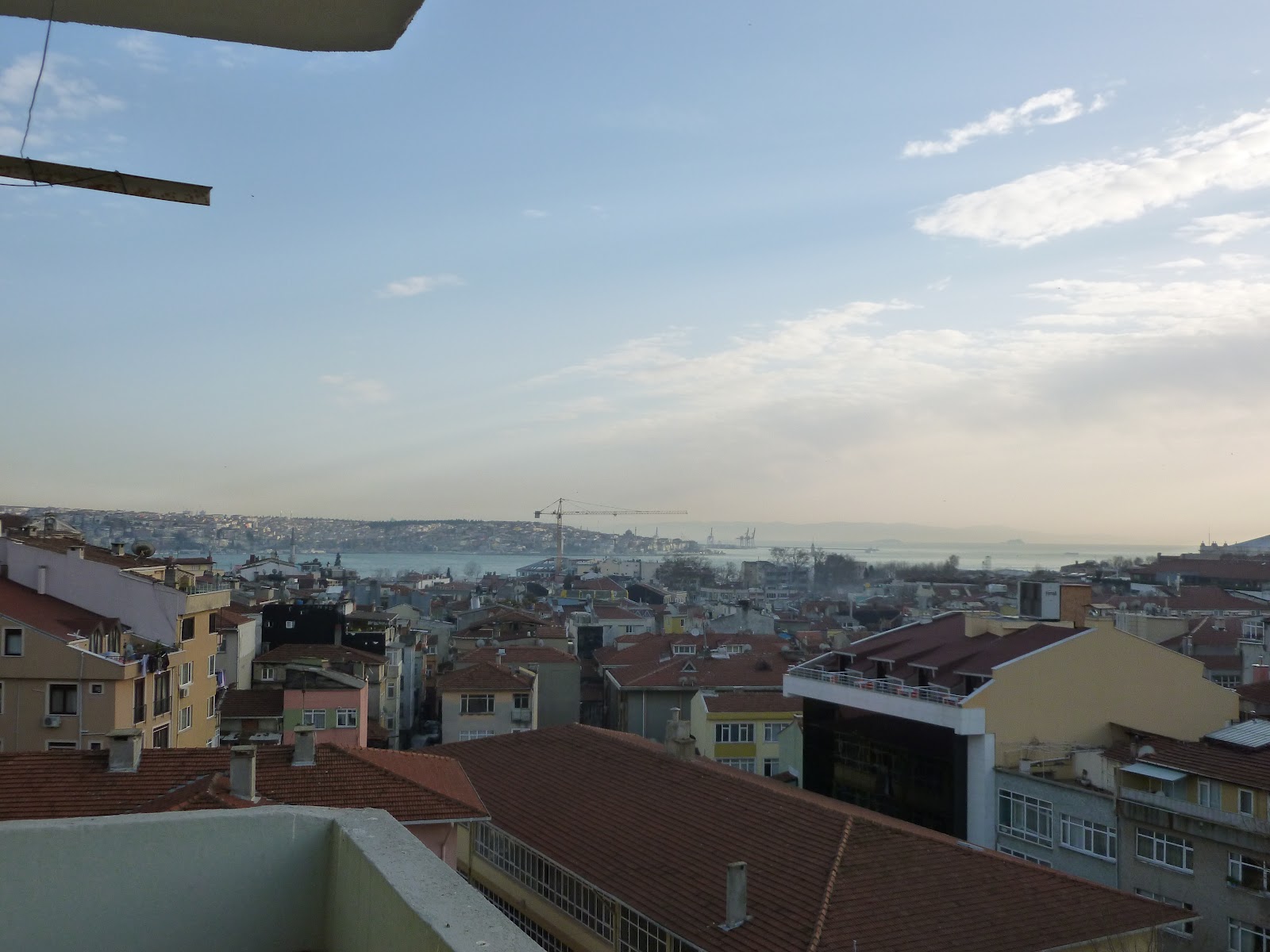
Lors de mon séjour à Istanbul, j'habite à Beşiktaş (se prononce bechiktach) situé au bord du Bosphore ce qui résulte une magnifique vue du balcon de l'appartement. C'est une place centrale très bien situé, proche de tout. En seulement 5 min de marches je suis au bord du Bosphore qui sépare la côte asiatique de la côte européenne de la ville. Mis à part les grands boulevard, les rues de mon coin sont étroites et fait de bloc de pierre qui donne un charme rustique. Il y a différents commerce de tous genre, des magasins moderne et une grande variété de restaurants et café en plus des divers stands de pain simit (bagel turque). Ça m'a pris quelques jours pour savoir m'y situer, je commencer à être à l'aise pour me déplacer.

Malgré ma connaissance de quelques mots turque, mon language et ma compréhension reste très limité avec ceux-ci et se résument pour l'instant avec des signes et les mots de base tel que bonjour et merci. Jusqu'à maintenant, ça a bien été. Évidamment ça me restreint un peu, mais j'ai le temps.

Vue du port/Port view
Aujourd'hui, j'ai explorer un peu plus le port et les quais de Beşiktaş où des divers bâteaux partent fréquemment pour la rive asiatique. Se promener au bord de la rive est très agréable, je le ferais sans doutes souvent, il y a des bancs à la disposition des Istanbuliotes pour profiter de la vue et de l'air marin.

Aussi, j'ai eu l'agréable surprise de voir des hommes pêcher dans le Bosphore. Je savais déjà que ça se faisait, mais j'ignorais que je le verrais aussi tôt et aussi près de la place où j'habite. Les poissons pêchés peuvent être mangés à la maison, c'est impressionnant et pas bête du tout.

Le thé turque est une boisson nationale en Turquie. Tout le monde en boit à tout moment de la journée, même moi qui est arrivé depuis quelques jours j'ai commencé à en boire très fréquemment puisque ma coloc turque en fait au moins 5 fois par jour (c'est très approximatif, parfois plus) et aussi parce qu'il est très bon. On peut se procurer un verre de thé absolument partout, de petites tables basses de bois sont souvent placés devant les commerces dans les rues, dans les parcs et dans les ports. Il est de coutume dans la grande hospitalité turque d'offrir le thé.

Au bout d'un jour ou deux, je suis arrivé à sortir quelques notes de la flûte kawala. La manière de travailler est de souffler ici et là durant la journée, ainsi quand c'est trop difficile, j'arrête et je recommence tout simplement un peu plus tard. Apprendre un nouvel instrument est très excitant!

======
Since my return from Büyükada, the weather completely change from winter to springs.  So we had a wonderful sunny Sunday with a weather of 12 C, all snow gone. But apparently, nature mother like to play some trick to Istanbul to and the weather might go down again around 0 C during the week.
During my time in Istanbul, i live in Beşiktaş (pronounced bechiktach) located next to the Bosphorus. That’s result a beautiful point of view from the balcony of the apartment. It’s a central place, well located, close to everything. In only 5 min i’m along the Bosphorus and see the Asian coast on the other side. Except 2 or 3 big boulevard, streets of my neigborhood are pretty tight and made with bricks or stones which it give a charming rustic style.  There different commerce of all kind, modern shop, large variety of restaurants and coffee place and also some bread simit stands. (turkish bagel). It took me a few days to get well located, i begin to fell comfortable to get around.


Despite my knowledge of a few turkish words, my language and my comprehension still very limit. For the moment, it is resume by signs and basic words such a hello and thank you.  Till now, it went well. Of course, it restrained a little bit, but i have time.


Pêcheurs sur le Bosphore/ Fishing on the Bosphorus
Today, i explore a little bit more the port and the docks of Beşiktaş where there different kind of boats frequently crossing to the asian side. Walking along the shore is really nice, i will certainly do it more often, there somes bench for the people of Istanbul for benefit the view and the sea air.


Also i had the nice surprise to see somes mens fishing on the Bosphore. I already knew that it was possible, but i didn’t expected to see so early and so close to place wher i live. They took home the fishs for cooking them, it’s amazing and not a bad idea at all.


Turkish tea is a national beverage in Turkey. Everybody drink it at all times during the day, even me who only arrived since a few days i get used to it since my turkish roommate do some tea around 5 times a day (very approximate, even more) and also because it is very good. We can get tea absolutely everywhere, some small wood tables are often along the streets, in the park and the port. This is a coutume in the turkish hospitality to offer tea.


At the end of one or two days, i got a few notes with the kawala flute. The way of practicing is to breathe in it here and there during the day, then when this is to difficult, i stop and i simply start again later. Learning a new instrument is very exciting!


Saturday, February 4, 2012

Une journée à Büyükada/ A day at Büyükada

Adalar/îles des princes/princes islands
Le dernier message m'a pris tellement de temps, que je vais plutôt éssayer d'en écrire des plus petit, plus souvent. Ça va sans doute varier selon l'humeur. Tant à partager.
Aujourd'hui j'ai été sur l'île Büyükada, la plus grande d'un archipel de neuf îles nommés Îles des Princes (adalar en turque) situé dans la mer Marmara. Ce sont des îles habitables et paisible puisque aucunes voitures ne circulent sur les routes. Ils sont remplacés par la marche à pied, les bicyclette ou les calèche de chevaux.
Pour s'y rendre, il faut prendre un bâteau, j'ai appris à mes dépend qu'il y a 2 sortes de bâteaux qui s'y rendent. En premier, j'ai pris celui à moteur, plus cher (5LT=2,85 cad), plus petit, plus vite. Au retour j'ai pris celui à vapeur, plus authentique, plus beau, plus grand, plus sophistiqué, moins cher (4LT=2,25 cad), mais plus long puisqu'il traverse d'abord vers sur la côte asiatique à Kadikoy et s'arrête ensuite sur trois îles avant d'y être tandis que celui à vapeur s'arrête seulement sur une seule avant Büyükada. Avec grand bonheur, Istanbul s'est enfin montré sous un soleil étonnamment chaud et radieux ce qui a  rendu les deux voyages sur la mer et l'escapade sur l'île très agréable. Je suis allé à l'île Büyükada parce que Richard, le saxophoniste qui a généreusement accepté de me partager son savoir, y habite. À mon grand bonheur je vais le faire presque une fois par semaine, une escale sur cette île paisible avec ses ports, plages, et forêt qui donnent une allure champêtre permet de sortir un peu de l'animation d'Istanbul.
Résumé de la première rencontre: Richard m'a fortement conseillé de profiter de mon séjour à Istanbul pour apprendre un instrument traditionnelle afin de mieux comprendre et développer avec sensibilité le style balkan/turque. Ainsi, il a été décidé qu'en parallèle avec les cours de saxophone, j'apprendrais la kaval. La kaval est une longue flûte joué dans la musique turque et des balkans. Toutefois pour commencer, Richard m'a prêté une kavala (ou kawala), une flûte plus petite principalement joué dans la musique arabe du Sud-Est de la Turquie, la Syrie, l'Égypte, la Jordanie et même au Maroc où elle a un nom différent. La seule grande similitude avec la kaval est la manière de souffler, étant donné qu'elle est plus petite, il sera plus facile de pratiquer à y sortir un son convenable, qui peut prendre des jours. Lorsque j'y arriverais, on "switche" sur la kaval pour apprendre les notions de base et si tout va bien, je vais peut-être prendre des cours privés avec un joueur de kaval professionnel par la suite. Entretemps, j'apprends au saxophone une chanson de style "Sasa" dont si je me rappelle bien est issue de la Macédoine. Dès les premières notes, il y a déjà de nouvelles ornementations qui rend le travail assez laborieux au départ. Avec le temps, l'apprentissage d'un répertoire très interressant se fera tout seul, tranquillement mais surement!
architecture ottoman
Nous nous sommes ensuite promené un peu sur l'île, d'abord dans une charmante forêt de petits pins avec des points de vues magnifique sur les autres îles et la mer avec la belle lumière du coucher de soleil. Ensuite au village, où il y a une belle ambiance et esprit bon vivant.
Au final Büyükada est une île avec des maisons très hétéroclyte principalement fondés à la fin du 19ème siècle, certaines sont en bois, d'autre représente l'architecture typique ottoman, d'autre de style art nouveau. ect. Il y a aussi énornément de chats et de chiens errant, j'en ai même eu un qui m'a suivi longtemps alors que je me rendais chez Richard, peut-être le verrais-je la prochaine fois, à suivre.
Sur la route de retour en bâteau, j'ai rencontré deux musiciens italiens doués qui jouaient spontanément sur le bâteau un répertoire de musique italienne, albanie, europe de l'est.ect , j'ai échanger quelques notes avec eux tandis que le bâteau traversait le Bosphore. Ça termine la journée sur la bonne note!
Petite anecdote: Pour se diriger à Istanbul on ne donne pas naturellement l'adresse exacte ou la rue. On donne plutôt des points de repères par exemple à côté d'une telle mosquée, la maison est telle couleur, tu tourne à gauche à telle statut.ect. Je commence à bien me situer du moins dans mon coin, c'est un jeu de mémoire ou de déjà vu, "si la rue ne me dit rien, ce n'est pas celle là, c'est donc l'autre...", je retourne sur mes pas et je recommence. Tout en étant prudente, j'ai aussi adopté un visage impassible lorsque je me perds, je sourie même, en fait c'est un sorte de masque pour cacher ma légère nervosité.
Enfin je tiens à terminer ce topic par une triste et importante nouvelle que j'ai appris aujourd'hui. J'avais prévu aller au fameux bar où le fameux clarinettiste turque Selim Sesler joue chaque mardi, j'en ai entendu parlé depuis des années et j'étais bien impatiente de voir enfin ça. Malheureusement, le bar est maintenant fermé et Selim Sesler ne va pas bien, il est dans les soins intensifs depuis quelques mois en attente d'un nouveau coeur, apparament il ne pourra plus jouer... Une pensée donc pour ce clarinettiste formidable et inspirant que je souhaite qu'il passera à travers cette dure période, bon rétablissement.

===================================

Port Büyükada/Büyükada port

The last message was a bit long and took me a lot of times, i will try to write more regularly smaller one.  Anyway it will certainly depend of my mood.  So much to share.
Today i wen on Büyükada island, the bigger one of an ensemble of nines islands called “Princes Islands (Adalar in turkish) located in Marmara sea. People living on these peaceful island. They’re no cars on the islands, it is replace by walking, cycling and carriage with horses. For getting there, we have to take a boat. I learn by myself that there two different types of boats. At first i took the boat with a motor, more expensive (5LT=2,85cad), more small but more fast. For the return i took the steamboat, more authentic, more beautiful, bigger, sophisticated, cheaper(4LT=2,25 cad), but took longer time to get on Büyükada because he stop on the other side of the Bosphore at Kadikoy and on 3 islands, the motor one just stop to one island before Büyükada. With lot of joy, Istanbul finally show itself under a beautiful and incredibly warm sun that makes the trips very pleasant. I came to Büyükade island becaus Richard, the saxophonist who generously accept to share his knowledge live there. I’m more than ok with this, i will do this little trip maybe once a week, a stop on this peaceful island with its ports, beach and forest give something very special for getting a little out of the lively city of Istanbul.
Summary of the first meeting. Richard higly recommend me to take the occasion of my time in Istanbul to learn a traditional instrument. By this way, i will understand and develop a certain sensibily with the Balkan/turkish style. Ainsi, it was decided that i will learn the kaval at the same time of the saxophone. Kaval is a long flute played in Turkey and Balkans. But for beginning, Richard lent me a kavala (or kawala), a smaller flute mainly played in arab music of south-east Turkey, Syria, Egypt, Jordan and also in Morroco where it is name differently. The similitude of this flute with the kaval is only the way to breath in it. Because it is smaller, it will be more easy to find the correct sound, that will take me a few days. When i will got it, i will switch to the kaval and learn the base with Richard. If it’s going good, i might take private lesson after with a professional kaval player, we’ll see.  By the same time, i learn a very interressant repertoire. We begun today with a “Sasa”, if i remember well this is from Macedonia. From the first notes, there already been new complex ornementations. The work start difficult, but with the time, i will get a more regular rythm, slowly but certainly!
We took a little walk afteron the island, at first a charming forest of littles pines with beautiful point of view of the other island and the sea with the sunset that was simply magic. After we went to the village where there a good and convivial ambiance.
Coucher de soleil sur le Marmara/ Sunset on Marmara
Finally Büyükada is a island with heteroclite houses mainly founded at the beginning of the 19th century, some are made in woods, other represent the ottoman typical architecture, other “art nouveau”.ect. There also a lot of errant cats and dogs. Even one followed me for a long time while i as searching Richard place.
On my way back on the boat, i met two talented Italian musicians spontaneously playing  a repertoire of traditional music from italia, Albania, Balkan.ect. I played a little with them at the end while the boat was crossing the Bosphorus. A good way to end the day on a good note!
Little anecdote: For get located in Istanbul, we don’t usually give an exact address ou road. Instead we give some landmark. By exemple, next to a mosque, the house is in this color, turn left at this statut.ect. I begin to find well my way in my neigbourhoud, it’s a kind of memory game. I stay  careful, i also adopt an impassive face when i have the feeling of geething lost, in fact this is a mask for hide my tiny nervosity. Finally, i want to finish this topic with a important and sad new.  I scheduled to finally going to the bar where Selim Sesler, a famous turkish clarinettist who play there each tuesday. Unfortunatly the bar is now close and sadly Selim Sesler not going well, he’s in intensive care since a few months waiting for a new heart, apparently he will not be able to play anymore... So a thought for this amazing and inspiring musician. I wish him the best to pass through his pain,  and a good recovery.


Friday, February 3, 2012

Premiers moments/ First Moments

Somewhere over white Turkey.
Avant de passer à travers la sécurité, il y a eu beaucoup d'émotions dans l'air lors d'un dernier regard à ma famille et mon amoureux que je ne vais pas voir jusqu'à la mi-avril.
Je ne parlerais pas trop des vols un peu banals a raconté, mais voici quelques trucs que je vais me rappeller à l'avenir:
-Partir en hiver équivaut à beaucoup de retard dans tous les aéroports que ce soit Montréal, Paris ou même Turquie où il y avait de la neige, évènement très rare dans ce pays.
-Un siège côté couloir est bien pour quelqu'un qui va souvent au petit coin.
-Un siège côté fenêtre est mauvais pour quelqu'un qui va souvent au petit coin.
-Un siège côté fenêtre serait plus agréable si ça ne serait pas au niveau de l'aile de l'avion.
-Les sécurités diffèrent selon le pays. Très relax au Canada, très stressé en France. 

Toutefois, le voyage musical a commencé plutôt que prévu. Lors du vol Paris/Istanbul, j'étais assise à côté d'un homme dans la quarantaine originaire du Montenegro (Serbie) nommé Stavo. Tout d'abord, nous avons eu une conversation interressante sur la différences et les similitudes de prononciations dans la langue des balkans. Par exemple, le serbe, le bosnien et le croate sont tous des langues presque similaires, chacun comprends l'autre même si ce n'est pas sa langue. Je me rappelle qu'il m'avais expliqué pourquoi, mais malheureusement avec toutes les aventures depuis et la fatigue accumulée je ne suis pas capable de l'expliquer ici. Il m'a également partagé avec générosité son savoir sur la musique des Balkans. La musique Croate ,que je ne connais pas beaucoup, et ses différents styles musicaux de chants. Ainsi j'ai découvert le Sotto Vocce, chants traditionnels très particulier du Dalmatia région de la croatie qui borde la mer donc voici un exemple vocal http://www.youtube.com/watch?v=oEuKJMnOypk. Aussi il m'a donné quelques noms d'artiste tel que Vlatko Stefanovski un grand guitariste, mandoliniste et chanteur qu'il décrit je cite "Musicians most famous than Goran Bregovitch, more sofisticated, much better". Nous avons aussi beaucoup parlé de Sevda ou "Sevdalinka" décrite comme des chansons d'amour, c'est un style de musique typique particulier à la Bosnie qui est joué avec beaucoup de coeur. J'ai déjà été en contact avec cette musique par l'intermédiaire de ma rencontre avec l'accordéoniste bosnienne Merima Kjuco l'été dernier. Stavo m'a conseillé de voir ce vidéo de deux artistes connus qui interprètent la musique bosnienne en style renaissance. Amira Mednunjanin  (voix) et Edin Karamazov(luth):  http://www.youtube.com/watch?v=BA2TbQrAHBY 
Je trouve toujours extrêmement interressant de voir le point de vue de quelqu'un de la région tel que Stavo pour parler de la musique des balkans, c'est une excellent façon de reconnaître l'authenticité.

Arrivé à Istanbul sous la neige et passé les douanes. L'aventure commence. L'autobus que je devais prendre n'était pas disponible. (sans comprendre pourquoi). Je me suis donc risqué à prendre un "Taksi" dont mon petit guide lonely planet conseille fortement d'éviter. En effet, ils ne savent pas conduire. Plus d'une fois il répondait à son téléphone, regardait la feuille des indications que je lui ai donné sans regarder la route, s'est arrêté à une station pour remplir l'essence et à même demander à deux reprises les directions à quelqu'un dans la rue. Arrivée saine et sauve à l'appartement avec mes bagages, ma nouvelle coloc Seda, une sympathique turque m'a acceuillie et m'a aussitôt fait du thé et un petit grill-cheese avec de la charcuterie qui étaient les bienvenues.
À peine établit, je devais partir voir le spectacle de Kolektif Istanbul avec le saxophoniste avec lequel je vais prendre des leçons. Je me suis ainsi risqué pour la première fois dans le labyrinthe d'Istanbul. Au départ, j'étais censé suivre le plan que ma coloc m'a dessiné pour aller m'acheter une carte mensuelle devant les transport, mais arrivé devant la machine, je n'avais aucunes idées comment elle fonctionnait, j'ai ainsi pris un second "taksi" avec une route sans encombre (sauf qu'il a appellé une fois) auquel je lui ai donné le plan que ma coloc avait dessiné. Débarqué au centre-ville, je demande à une dame turque la direction pour la place du spectacle, je m'y rend sans problème et j'assiste à un spectacle tout simplement incroyable. Indescriptible, j'ai pris quelques vidéos et photos. Musiciens virtuose, bons arrangements, très belle énergie et complicité entre les musiciens. Habitués aux rythmes irréguliers, je n'avais pas de difficulté à taper le rythme et danser, mais quelle fût mon agréable surprise de voir le public en faire autant et même éxécuter quelques pas de danse traditionnelles. Très belle soirée.

J'ai enfin rencontré Richard. Ne voulant pas me risquer à me perdre au milieu de la nuit, j'ai accepté de dormir chez l'amie française de celui-ci qui habite dans un très bel appartement non loin de la place du concert. Pour s'y rendre, nous avons marchés tous ensemble sur la grande avenue Istilkal et j'ai parlé avec Richard des bulgares turcophones (langue marternelle turc) pour comprendre ce style de musique turco-balkanique. Il a donné l'exemple du célèbre clarinettiste bulgare Ivo Papasov dont son nom turque est Ibrahim Abbas.

Enfin mes premières impression de Turquie. Aussitôt arrivé à Istanbul, j'ai immédiatement sentie un sentiment naturel d'être là. Je me suis aussi bien préparé, appris la langue, informé sur la culture.ect. J'arrive à un moment tranquille où tout le monde travaille et qu'il fait froid, les turques n'y sont pas habitués et une mince couche de neige peut facilement devenir  un inconvénient. Mais malgré le froid, la ville demeure active et conviviale. Les turques sont naturellement serviables et d'une belle gentillesse. J'ai appris que le système de canalisation (très vieux) n'est pas très bon, il est donc difficile parfois de "dealer" avec la douche ou la toilette. C'est également une ville où il n'est pas rare de voir une ruines quelquonque vielle de 600 ans au milieu de la ville. Il y a beaucoup de vielles rue style piétonnière fait de pierres, ce qui fait son charme.

La priorité au piéton n'existe pas, je le savais déjà avant d'arriver, mais quand même. Ils traversent n'importent où tandis que les voitures zig zagent dans les rues (tout en ignorant les lignes qui sont selon moi purement décoratives).  Heureusement, j'ai rapidement compris qu'en traversant en même temps que les habitués de la ville est la manière la plus sécuritaire.
 Enfin le seul grand inconfort est que c'est un véritable labyrinthe très difficile de se situer, les noms de rues ne sont pas toujours écrits. Sans doutes avec le temps je trouverais manière de ne pas me perdre, les Istambuliotes sont toujours là pour m'aider et j'ai déjà trouvé quelques trucs, c'est ce qu'on appelle l'adaptation. 

==========================================

Before passing take the plane. They were a lot of feelings in the air in the instant of a last look at my family and my love that i will not see until mid-april.
I will not talk about normal flight but here are some tips for myself i will remember next time.
-Leaving during winter cause a lot of delays in all the airport. Montreal, Paris and even Turkey were it was snowing, really rare for this country.
-A seat next to the corridor is nice for someone who’s going a few time to the bathroom.
-A seat next to a windows is not nice for someone who’s going a few time to the bathroom.
- A seat next to the windows could be more pleasant if it is not on the same level as the wing.
-Security are different between countries. Pretty relax in Canada, really stressful in France.
However, my musical trip began earlier than i thought. During the flight between Paris and Istanbul, i was sit next to a men about forty native from Montenegro (Serbia) named Stavo. At first, we had a very interressant conversation about similarities and differences of the prononciations in Balkan language. By example, Serbian, Bosnian and Croatian languages are pretty similar. They could understand each other even if this is not their maternal language. I remember that he explain me why, but unfortunately with all the adventures since and accumulation of tiredness i will not be able to give the explanation here. He also share with generosity his knowledge about Balkan music. Croatian music that i don’t know have some  distinct and unique folkloric songs. So i discover the “Sotto vocce”(under voice) , traditional song style  from Dalmatia, the region of Croatia next to the sea with intriguing harmony. Here a video vocal exemple: http://www.youtube.com/watch?v=oEuKJMnOypk . Also, he gave me a few artists names such as Vlatko 
Stefanovski a great guitarist, mandolinist and singer described as “most famous than Goran Bregovitch, more sophisticated, much better” according to the words of Stavo. We also talk about Sevda or “Sevdalinka” described as traditional love songs mostly from Bosnia. That is played a lot with the heart and soul. I already been in contact with this music by meeting the accordionist Merima Kjuco last summer. Stavo advised me to see this nice video with two famous artists performing Bosnian music converted in a middle edge music  with Amira Mednunjanin (voice) and Edin Karamazov (luth): http://www.youtube.com/watch?v=BA2TbQrAHBY 
I always found extremely interressant seeing the point of view of someone of this region as Stavo for talking about Balkan music, this is an excellent way to learn the authenticity.
Arrived in Istanbul under the snow. The journey begins. The bus that i was supposed to take wasn’t available (without knowing why). So i took the risk to take a “Taksi” that my lonely planet book higly suggest to avoid that. Indeed, they don’t know how to drive.  More than once, he answer his cell phone, look at the direction sheet i gave to him without watching in front, he stopped at a station gas and ask twice for the directions to someone in the streets. Safe arrived at the apartment, my new roommate Seda, a sympathic Turkish girl greet me and immediatly offer me a tea and a delicious little gril-cheese more more than welcome. 
I left after for see the show of Kolektif Istanbul, a very good band with the saxophonist who will give me lessons. This is how i was for the first time alone in the maze of Istanbul. At the beginning, i was suppose to follow the plan that my roommates draw for me with the directions for get a akbil card (equivalent of opus in Montreal). But arrived in front of the machine, i had no ideas how it work. Finally i took a second “taksi” the road was ok (except one call for get the directions), i gave him the plan my roommates did for me. In downtown i ask to a Turkish woman the direction for the Babylone  and i’m getting there without problems. That was a simply amazing show.  I’m without words to describe how it was.  I took somes photos and videos. Virtuose musicians, good arrangement, very nice vibe and complicity between the musicians. Used to the irregular rythm such as 9/8 and 11/8, it was natural to clap the rythm and dance, but it was a nice surprise to see the audience doing it as well and even execute a few traditional dance steps. Very nice evening.
I finally met Richard. I didn’t want to risk to get lose in the middle of the night so i accepted to sleep at the apartment of a French friend of Richard who was living near of the Babylone (concert place).  For getting there, we walked all together on the famous Istiklal avenue and i had a nice talk with Richard about Bulagrian who speak turkish as a maternal language, it help a lot to understand the origins of the turco-bakanic style. He gaved the exemple of Ivo Papasov a well know Bulgarian clarinettist whose his turkish name is Ibrahim Abbas.
Gel rare à Istanbul/ Unusual ice in Istanbul.
Finally my first impressions about Turkey. Once i get in Istanbul, i immediately fell a natural feeling being there. I’m well prepared, learned the language, inform about the culture. Ect. So the cultural choch is not that big. I arrive in the time of the year where everyone working and it’s cold. Turkish are not used to it, a small layer of snow can easily be an inconvenient. But without the cold, the city still pretty active and friendly. Turkish are kind and helpful people. Canalisation in Istanbul is pretty old and not very good, so it’s difficult sometime to deal with the shower or the toilet. It is natural to see an  ancient ruins 600 years old in place in the city that you not expect to see there. There a lot of ancient road made with stones, which it give its charm. Priority to pedestrians do not exist, i already know it before getting there, but still. They cross the streets everywhere while the cars ignore the lines on the road. (i think they’re just decorative). Fortunatly i rapidly understand that crossing the street at the same time as other people used to it is to most safe way. The only discomfort is that Istanbul is a maze, difficult to be located and we don’t always see the name of the streets. I have no doubt that i will find somes ways to not get lost, the Istanbuliotes are always there to help you and i already found somes tips actually. This is what we call adaptation!